
Dificultades en la comprensión de las fases de la Luna y los eclipses: revisión sistemática de la literatura
DOI
https://doi.org/10.25267/Rev_Eureka_ensen_divulg_cienc.2026.v23.i1.1104Información




Autores/as
- Elvira Gutiérrez-Jiménez (ES) Departamento de Física Aplicada, Escuela de Ingeniería de Bilbao. Universidad del País Vasco (UPV/EHU) https://orcid.org/0009-0000-9038-8974
- Ane Portillo-Blanco (ES) Departamento de Física Aplicada, Escuela de Ingeniería de Gipuzkoa. Universidad del País Vasco (UPV/EHU)
- Paulo Sarriugarte (ES) Departamento de Física Aplicada, Escuela de Ingeniería de Bilbao. Universidad del País Vasco (UPV/EHU) https://orcid.org/0000-0003-0225-9158
- Kristina Zuza (ES) Departamento de Física Aplicada, Escuela de Ingeniería de Gipuzkoa. Universidad del País Vasco (UPV/EHU) https://orcid.org/0000-0002-4455-0165

Resumen
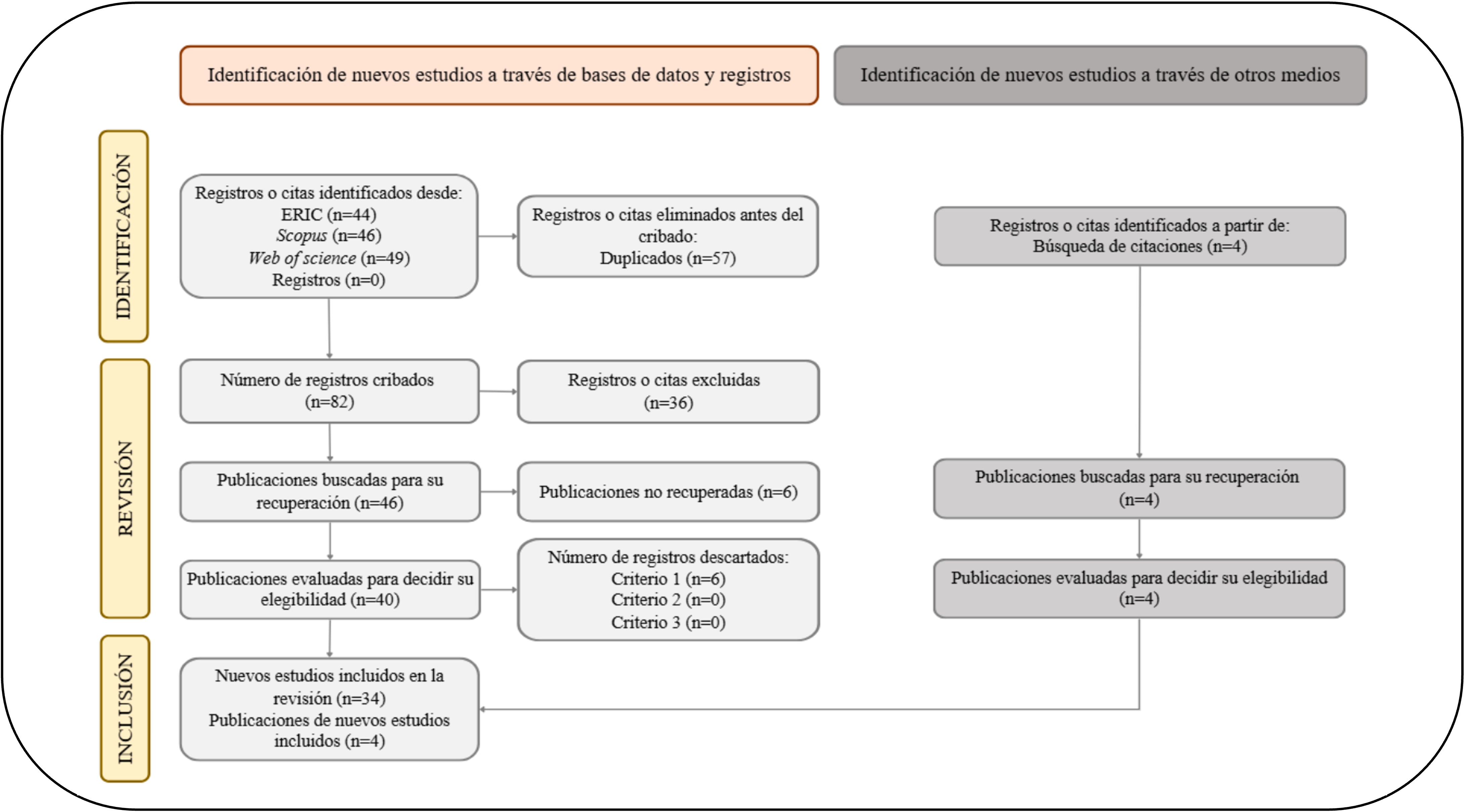
En este estudio se identifican las dificultades de aprendizaje relacionadas con las fases de la Luna y los eclipses reportadas en la literatura. Para ello, se ha llevado a cabo una revisión sistemática en las bases de datos ERIC, Scopus y Web of Science, siguiendo la declaración PRISMA 2020. Se analizan 38 publicaciones que cumplen los criterios de inclusión establecidos. Los resultados obtenidos se agrupan en cuatro categorías principales basadas en la jerarquización de conceptos y en la progresión e interrelación de los conceptos astronómicos: (C1) aspectos básicos del sistema Sol-Tierra-Luna (escala y tamaño relativo, órbitas, movimientos celestes, reflexión de la luz solar), (C2) fases de la Luna, (C3) relación entre fases de la Luna y eclipses (posición de los astros y fase lunar correspondiente en cada tipo de eclipse, razón por la que no hay eclipses en cada fase nueva o llena y el concepto de línea de nodos) y (C4) eclipses lunares y solares. Las dificultades identificadas se presentan en distintos agentes que participan en el proceso de enseñanza-aprendizaje a nivel internacional incluyendo alumnado de primaria, secundaria y universidad, profesorado en formación (procedente de grados de educación y graduados en ciencias) y profesorado en activo. Se concluye que las dificultades descritas son similares en los niveles educativos que se tratan en las publicaciones, y algunas de ellas resultan generalizables.
Palabras clave

Descargas
Agencias de apoyo
Cómo citar
Licencia
Derechos de autor 2025 Elvira Gutiérrez-Jiménez, Ane Portillo-Blanco, Paulo Sarriugarte, Kristina Zuza

Esta obra está bajo una licencia internacional Creative Commons Atribución-NoComercial 4.0.
Aquellos autores/as que tengan publicaciones con esta revista, aceptan los términos siguientes:
- Los autores/as podrán conservar sus derechos de autor y garantizarán a la revista el derecho de primera publicación de su obra, el cual estará simultáneamente sujeto a la Licencia de reconocimiento de Creative Commons que permite a terceros compartir la obra siempre que se indique su autor y su primera publicación esta revista.
- Los autores/as podrán adoptar otros acuerdos de licencia no exclusiva de distribución de la versión de la obra publicada (p. ej.: depositarla en un archivo telemático institucional) siempre que se indique la publicación inicial en esta revista.
- Se permite y recomienda a los autores/as difundir su obra a través de Internet (p. ej.: en archivos telemáticos institucionales o en su página web) una vez el manuscrito sea aceptado, lo cual puede producir intercambios interesantes y aumentar las citas de la obra publicada. (Véase El efecto del acceso abierto). También se permite la difusión de la versión pre-print de los artículos a partir del momento en que son aceptados o publicados
Reconocimiento-NoComercial
CC BY-NC
Citas
Ahlgren, A. (1996). Better Rather than More Astronomy Education. En J. Percy (Ed.), Astronomy education: current developments, future coordination (vol. 89 pp. 26-32). Astronomical Society of the Pacific.
Ananda, L. y Syuhendri, S. (2023). Misconceptions of prospective physics teacher students on the period of lunar phases. AIP Conference Proceedings, 2619(1). https://doi.org/10.1063/5.0122687
Azizah, S. N., Akhsan, H., Muslim, M. y Ariska, M. (2022). Analysis of college students misconceptions in astronomy using four-tier test. Journal of Physics: Conference Series, 2165(1), 012004. https://doi.org/10.1088/1742-6596/2165/1/012004
Barnett, M. y Morran, J. (2002). Addressing children’s alternative frameworks of the Moon’s phases and eclipses. International Journal Of Science Education, 24(8), 859-879. https://doi.org/10.1080/09500690110095276
Bektaşli, B. (2013). The development of astronomy concept test for determining preservice science teachers’ misconceptions about astronomy. Eğitim Ve Bilim, 38(168), 362-372.
Bell, R. L. y Trundle, K. C. (2008). The use of a computer simulation to promote scientific conceptions of moon phases. Journal Of Research In Science Teaching, 45(3), 346-372. https://doi.org/10.1002/tea.20227
Callison, P. L. y Wright, E. L. (1993). The Effect of Teaching Strategies Using Models on Preservice Elementary Teachers Conceptions about Earth-Sun-Moon Relationships. Annual Meeting of the National Association for Research in Science Teaching.
Chen, C., Sonnert, G., Sadler, P. M. y Sunbury, S. (2020). The Impact of High School Life Science Teachers’ Subject Matter Knowledge and Knowledge of Student Misconceptions on Students’ Learning. CBE—Life Sciences Education, 19(1), 1-16. https://doi.org/10.1187/cbe.19-08-0164
Cox, M., Steegen, A. y De Cock, M. (2016). How Aware Are Teachers of Students’ Misconceptions in Astronomy? A Qualitative Analysis in Belgium. Science Education International, 27(2), 277-300.
Dahsah, C., Phonphok, N., Pruekpramool, C., Sangpradit, T. y Sukonthachat, J. (2012). Students’ conception on sizes and distances of the earth-moon-sun models. European Journal of Social Sciences, 32(4), 583-597.
Davis, H., Milotte, C. y Odenwald, S. (2024). Total Solar Eclipse Misconceptions: Evolving mental models. Bulletin Of The AAS, 56(3). https://doi.org/10.3847/25c2cfeb.ed0296bb
Frede, V. (2006). Pre-service elementary teacher’s conceptions about astronomy. Advances In Space Research, 38(10), 2237-2246. https://doi.org/10.1016/j.asr.2006.02.017
Favia, A. (2014). An Inventory of Student Recollections of Their Past Misconceptions as a Tool for Improved Classroom Astronomy Instruction [Tesis de Doctorado, The University of Maine].
Govender, N. (2011). South African primary school teachers’ scientific and indigenous conceptions of the Earth-Moon-Sun system. African Journal Of Research In Mathematics Science And Technology Education, 15(2), 154-167. https://doi.org/10.1080/10288457.2011.10740709
Hermann, R. y Lewis, B. F. (2003). Moon misconceptions. The Science Teacher, 70(8), 51-55.
Hicks, A. S. (2009). A.C.C.E.S.S. Alternative Conceptions: A Comprehensive Examination of Space Science [Tesis de Doctorado, Miami University].
Huerta-Cancino, L. (2017). Concepciones alternativas mayoritarias sobre Universo en profesores de Física en formación. Estudios Pedagógicos, 43(2), 147-162. https://doi.org/10.4067/s0718-07052017000200008
Kanli, U. (2014). A Study on Identifying the Misconceptions of Pre-service and In-service Teachers about Basic Astronomy Concepts. Eurasia Journal Of Mathematics Science And Technology Education, 10(5), 471-479. https://doi.org/10.12973/eurasia.2014.1120a
Küçüközer, H. (2007). Prospective Science Teachers’ Conceptions about Astronomical Subjects. Science Education International, 18(2), 113-130.
Ogan-Bekiroglu, F. (2007). Effects of Model‐based Teaching on Pre‐service Physics Teachers’ Conceptions of the Moon, Moon Phases, and Other Lunar Phenomena. International Journal Of Science Education, 29(5), 555-593. https://doi.org/10.1080/09500690600718104
Page, M. J., McKenzie, J. E., Bossuyt, P. M., Boutron, I., Hoffmann, T. C., Mulrow, C. D., Shamseer, L., Tetzlaff, J. M., Akl, E. A., Brennan, S. E., Chou, R., Glanville, J., Grimshaw, J. M., Hróbjartsson, A., Lalu, M. M., Li, T., Loder, E. W., Mayo-Wilson, E., McDonald, S., ... Moher, D. (2021). The PRISMA 2020 statement: an updated guideline for reporting systematic reviews. BMJ, n71. https://doi.org/10.1136/bmj.n71
Park, S. (2013). The Relationship between Students’ Perception of the Scientific Models and Their Alternative Conceptions of the Lunar Phases. Eurasia Journal Of Mathematics Science And Technology Education, 9(3), 285-299. https://doi.org/10.12973/eurasia.2013.936a
Pintó, R., Aliberas, J. y Gómez, R. (1996). Tres Enfoques sobre la investigación enconcepciones alternativas. Enseñanza de las Ciencias, 14 (2), 221-232.
Plummer, J. D. (2014). Spatial thinking as the dimension of progress in an astronomy learning progression. Studies In Science Education, 50(1), 1-45. https://doi.org/10.1080/03057267.2013.869039
Rabanales, F. L. y Vanegas-Ortega, C. (2021). Concepciones alternativas sobre astronomía en estudiantes de educación básica y media de la Región Metropolitana de Chile. Estudios Pedagógicos, 47(2), 247-268. https://doi.org/10.4067/s0718-07052021000200247
Ritchie, S. M., Tobin, K. y Hook, K. S. (1997). Teaching referents and the warrants used to test the viability of students’ mental models: Is there a link? Journal Of Research In Science Teaching, 34(3), 223-238. https://doi.org/10.1002/(SICI)1098-2736(199703)34:3<223::AID-TEA2>3.0.CO;2-U
Rutherford, L. B. (2004). Exploring alternative conceptions of teachers and informal educators about selected astronomy concepts [Tesis de Doctorado, University of Cincinnati].
Sadler, P. M. (1996). Astronomy’s Conceptual Hierarchy. Astronomical Society of the Pacific Conference Series, 89.
Sadler, P. M., Coyle, H., Miller, J. L., Cook-Smith, N., Dussault, M. y Gould, R. R. (2010). The Astronomy and Space Science Concept Inventory: Development and Validation of Assessment Instruments Aligned with the K–12 National Science Standards. Astronomy Education Review, 8(1). https://doi.org/10.3847/aer2009024
Schoon, K. J. (1995). The Origin and Extent of Alternative Conceptions in the Earth and Space Sciences: A Survey of Pre-Service Elementary Teachers. Journal of Elementary Science Education, 7(2), 27-46. https://doi.org/10.1007/BF03173734
Shore, L. S. (1991). The Effect of Astronomy Teaching Experience on the Astronomy Interest and Conceptions of Elementary School Teachers [Tesis de Doctorado, Boston University].
Shtulman, A. y Lombrozo, T. (2016). Bundles of Contradiction: A Coexistence View of Conceptual Change. En D. Barner y A. S. Baron (Eds.), Core Knowledge and Conceptual Change (pp. 53-72). Oxford Academic. https://doi.org/10.1093/acprof:oso/9780190467630.003.0004
Slater, T. F. (2008). A Contemporary Approach to Teaching Eclipses. En J. C. Holbrook, J. O. Urama y R. T. Medupe (Eds.), African Cultural Astronomy (pp. 95-107). Springer. https://doi.org/10.1007/978-1-4020-6639-9_8
Slater, T. F. y Gelderman, R. (2017). Addressing students’ misconceptions about eclipses. The Physics Teacher, 55(5), 314-315. https://doi.org/10.1119/1.4981046
Slater, E. V., Morris, J. E. y McKinnon, D. (2018). Astronomy alternative conceptions in pre-adolescent students in Western Australia. International Journal Of Science Education, 40(17), 2158-2180. https://doi.org/10.1080/09500693.2018.1522014
Solbes, J. (2009). Dificultades de aprendizaje y cambio conceptual, procedimental y axiológico (I): Resumen del camino avanzado. Revista Eureka sobre Enseñanza y Divulgación de las Ciencias, 6(1), 2–20. https://doi.org/10.25267/Rev_Eureka_ensen_divulg_cienc.2009.v6.i1.01
Solbes, J. y Palomar, R. (2013). Dificultades en el aprendizaje de la astronomía en secundaria. Revista Brasileira de Ensino de Física, 35(1), 1401. https://doi.org/10.1590/s1806-11172013000100016
Sule, A. y Jawkar, S. (2019). Teacher’s misconception in curricular astronomy. EPJ Web Of Conferences, 200, 01012. https://doi.org/10.1051/epjconf/201920001012
Taber, K. S. (2015). Alternative conceptions/frameworks/misconceptions. En R. Gunstone (Ed.), Encyclopedia of science education (pp. 37-41). Springer. https://doi.org/10.1007/978-94-007-6165-0_88-2
Taylor, I., Barker, M. y Jones, A. (2003). Promoting mental model building in astronomy education. International Journal Of Science Education, 25(10), 1205-1225. https://doi.org/10.1080/0950069022000017270a
Testa, I., Galano, S., Leccia, S. y Puddu, E. (2015). Development and validation of a learning progression for change of seasons, solar and lunar eclipses, and moon phases. Physical Review Special Topics - Physics Education Research, 11(2). https://doi.org/10.1103/physrevstper.11.020102
Tetsuhide, S. (2023). Why Do Japanese Students Have Difficulties in Astronomical and Meteorological Fields?: Reform of Teaching Methods Based on Comprehension Surveys of University and High School Students. 12th International Conferences: New Perspectives in Science Education.
Thomas, N. J. (2021). Understanding and Addressing Preservice Elementary Teachers’ Misconceptions in Science Education [Tesis de Doctorado, University of Nevada]. UNLV Theses, Dissertations, Professional Papers, and Capstones.
Trumper, R. (2000). University students’ conceptions of basic astronomy concepts. Physics Education, 35(1), 9-15. https://doi.org/10.1088/0031-9120/35/1/301
Trumper, R. (2001a). A cross-age study of junior high school students’ conceptions of basic astronomy concepts. International Journal Of Science Education, 23(11), 1111-1123. https://doi.org/10.1080/09500690010025085
Trumper, R. (2001b). A Cross-age Study of Senior High School Students’ Conceptions of Basic Astronomy Concepts. Research In Science y Technological Education, 19(1), 97-109. https://doi.org/10.1080/02635140120046259
Trumper, R. (2001c). A cross-college age study of science and nonscience students’ conceptions of basic astronomy concepts in preservice training for high-school teachers. Journal Of Science Education And Technology, 10(2), 189-195. https://doi.org/10.1023/a:1009477316035
Trumper, R. (2003). The need for change in elementary school teacher training—a cross-college age study of future teachers’ conceptions of basic astronomy concepts. Teaching And Teacher Education, 19(3), 309-323. https://doi.org/10.1016/s0742-051x(03)00017-9
Trundle, K. C., Atwood, R. K. y Christopher, J. E. (2002). Preservice elementary teachers’ conceptions of moon phases before and after instruction. Journal Of Research In Science Teaching, 39(7), 633-658. https://doi.org/10.1002/tea.10039
Trundle, K. C., Atwood, R. K. y Christopher, J. E. (2007a). A longitudinal study of conceptual change: Preservice elementary teachers’ conceptions of moon phases. Journal Of Research In Science Teaching, 44(2), 303-326. https://doi.org/10.1002/tea.20121
Trundle, K. C., Atwood, R. K. y Christopher, J. E. (2007b). Fourth‐grade Elementary Students’ Conceptions of Standards‐based Lunar Concepts. International Journal Of Science Education, 29(5), 595-616. https://doi.org/10.1080/09500690600779932
Türkmen, H. (2015). After Almost Half-Century Landing on the Moon and Still Countering Basic Astronomy Conceptions. European Journal of Physics Education, 6(2), 1-17. https://doi.org/10.20308/ejpe.70434
Varela-Losada, M., Pérez-Rodríguez, U., Álvarez-Lires, M. y Arias-Correa, A. (2015). Concepciones alternativas sobre Astronomía de profesorado español en formación. Ciência y Educação (Bauru), 21(4), 799-816. https://doi.org/10.1590/1516-731320150040002
Vosniadou, S. (2019). The development of students’ understanding of science. Frontiers in Education, 4(32). https://doi.org/10.3389/feduc.2019.00032
Zeilik, M., Schau, C. y Mattern, N. (1998). Misconceptions and their change in university-level astronomy courses. The Physics Teacher, 36(2), 104-107. https://doi.org/10.1119/1.880056