
Scientific literacy in science education and science teaching: trends and gaps in intellectual production over the last 40 years
Downloads
- PDF (Español (España)) 860
- EPUB (Español (España)) 88
- VISOR (Español (España))
- MÓVIL (Español (España))
- XML (Español (España)) 61
DOI
https://doi.org/10.25267/Rev_Eureka_ensen_divulg_cienc.2025.v22.i2.2101Info




Authors
- Francisco Pérez-Rodríguez (CL) Facultad de Psicología e Instituto de Estudios Humanísticos "Juan Ignacio Molina". Universida de Talca. Chile https://orcid.org/0000-0001-9644-6848
- Geraldin Baquero-Mendieta (CL) Doctorado en Didáctica de las Ciencias Experimentales, Facultad de Ciencias Básicas, Universidad Católica del Maule. Chile https://orcid.org/0000-0003-2008-5542

Abstract
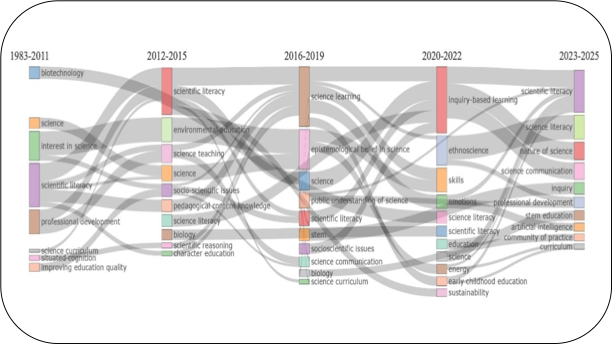
This bibliometric analysis describes and analyzes the intellectual production associated with scientific literacy, science education in the last 40 years. For this analysis, a search was performed in the Web of Science and Scopus databases, and the bibliometric data of 1225 documents were visualized using the Bibliometrix by Biblioshiny and VOSviewer software. The findings reveal an increase in reported research in the field over the past four decades, with a marked predominance of authors and journals originating from North American, Anglo-Saxon, and European regions. At the thematic level, basic topics related to the didactic nature of science teaching and learning processes are identified, but there also emerge themes linked to contemporary epistemologies, typical of critical theories. The study of scientific literacy is in an instance of mobilization -perhaps epistemological- between the paradigmatic dichotomy of scientific culture and critical scientific literacy (vision III), both tensioned by the science-society relationship. It is concluded that scientific literacy is a theme that is on the rise and tends to be more productive in the field of science education.Keywords

Downloads
Supporting Agencies
How to Cite
License
Copyright (c) 2025 Francisco Pérez-Rodríguez, Geraldin Baquero-Mendieta

This work is licensed under a Creative Commons Attribution-NonCommercial 4.0 International License.
Require authors to agree to Copyright Notice as part of the submission process. This allow the / o authors / is non-commercial use of the work, including the right to place it in an open access archive. In addition, Creative Commons is available on flexible copyright licenses (Creative Commons).

Reconocimiento-NoComercial
CC BY-NC
References
Acevedo Díaz, J. A. (2004). Reflexiones sobre las finalidades de la enseñanza de las ciencias: Edu-cación científica para la ciudadanía. Revista Eureka sobre Enseñanza y Divulgación de las Ciencias, 1(1), 3–16. https://doi.org/10.25267/Rev_Eureka_ensen_divulg_cienc.2004.v1.i1.01
Acevedo Díaz, J. A., Vásquez, Á. y Manassero, M. A. (2003). Papel de la educación CTS en una alfabetización científica y tecnológica para todas las personas. Revista Electrónica de Ense-ñanza de las Ciencias, 2(2), 80–111.
Adúriz-Bravo, A. y Aymerich, M. I. I. (2001). La didáctica de las ciencias experimentales como disciplina tecnocientífica autónoma. Revista Electrónica de Enseñanza de las Ciencias, 1(2), 291–302. https://dialnet.unirioja.es/servlet/articulo?codigo=6481275
Aikenhead, G. S. (1985). Collective decision making in the social context of science. Science Edu-cation, 69(4), 453–475. https://doi.org/10.1002/sce.3730690403
Aikenhead, G. S. (2007). Expanding the research agenda for scientific literacy. En C. Linder, L. Östman i P.-O. Wickman (Eds.), Promoting scientific literacy: Science education research in transaction (pp. 1–18). Uppsala University.
Alsop, S. y Bencze, L. (2012). In search of activist pedagogies in SMTE. Canadian Journal of Science, Mathematics and Technology Education, 12(4), 394–408. https://doi.org/10.1080/14926156.2012.732256
Asamblea General de las Naciones Unidas. (1948). Declaración Universal de los Derechos Hu-manos (217 [III] A). https://www.un.org/en/universal-declaration-human-rights/
Baker, H. K., Kumar, S. y Pattnaik, D. (2021). Twenty-five years of the Journal of Corporate Fi-nance: A scientometric analysis. Journal of Corporate Finance, 66, 101572. https://doi.org/10.1016/j.jcorpfin.2020.101572
Bazzul, J. y Tolbert, S. (2019). Love, politics and science education on a damaged planet. Cultural Studies of Science Education, 14(2), 303–308. https://doi.org/10.1007/s11422-019-09913-2
Bybee, R. W. (1979). La educación científica y la sociedad ecológica emergente. Science Educa-tion, 63(1), 95–109. https://doi.org/10.1002/sce.3730630110
Bybee, R. W. (1997). Lograr la alfabetización científica: De los propósitos a las prácticas. Heinemann.
Bybee, R. W. (2015). Alfabetización científica. En R. Gunstone (Ed.), Encyclopedia of science education (pp. 944–947). Springer.
Camacho, D., Oviedo, H., Ramos, E. y González, T. (2016). Bibliometric analysis of articles on nursing care published in Colombian magazines. Enfermería Global: Revista Electrónica Trimestral de Enfermería, 15(4), 406–416.
Coppi, M., Fialho, I. y Cid, M. (2023). Assessing Portuguese elementary school students’ scienti-fic literacy: Application of the ALCE instrument. Social Sciences, 12(7), 374. https://doi.org/10.3390/socsci12070374
de Bellis, N. (2009). Bibliometrics and citation analysis: From the Science Citation Index to cy-bermetrics. The Scarecrow Press.
Escorcia, T. y Poutou, R. (2008). Análisis bibliométrico de los artículos originales publicados en la revista Universitas Scientiarum (1987–2007). Universitas Scientiarum, 13(3), 236–244.
Freire, P. (1997). Pedagogía de la esperanza: Un reencuentro con la pedagogía del oprimido (2.ª ed.). Siglo XXI Editores.
García, C. A. (2015). Paulo Freire: El camino de la praxis pedagógica al inédito viable [Tesis de maestría, Pontificia Universidad Javeriana]. https://repository.javeriana.edu.co/handle/10554/17017
Gormally, C., Brickman, P. y Lutz, M. (2012). Developing a Test of Scientific Literacy Skills (TOSLS): Measuring undergraduates’ evaluation of scientific information and argu-ments. CBE—Life Sciences Education, 11(4), 364–377. https://doi.org/10.1187/cbe.12-03-0026
Goropečnik, L., Jošt, M., Oblak, L., Zupančič, A. y Kropivšek, J. (2021). Bibliometric analysis of scientific literacy using VOS viewer: Analysis of science education. Journal of Physics: Conference Series, 1796(1), 012096. https://doi.org/10.1088/1742-6596/1796/1/012096
Guerrero-Hernández, G., Rojas-Avilez, L. y González-Weil, C. (2023). Critical Scientific Literacy Approach and Critical Theories in the Learning of Science Outside the Classroom. En Springer eBooks (pp. 119-136). https://doi.org/10.1007/978-3-031-13291-9_7
Guerrero, G. y Sjöström, J. (2024). Critical scientific and environmental literacies: a systematic and critical review. Studies In Science Education, 1-47. https://doi.org/10.1080/03057267.2024.2344988
Guerrero, G. R. y Torres‐Olave, B. (2021). Scientific literacy and agency within the Chilean scien-ce curriculum: A critical discourse analysis. The Curriculum Journal, 33(3), 410-426. https://doi.org/10.1002/curj.141
Hernández, O., Sazo, J. y da Fonseca, P. (2021). Inclusión educativa de las personas con TEA: análisis bibliométrico de la literatura publicada en Scopus. Órbita Científica Revista Cien-tífico Pedagógica, 27(114).
Hodson, D. (2011). Looking to the future. Building a curriculum for social activism. Sense Pu-blishers.
Hurd, P. D. (1958). Scientific literacy: New minds for a changing world. Science Education, 82, 407-416.
Laherto, A. y Rybska, E. (2019). Scientific literacy and socio scientific issues. En The Beauty and Pleasure of Understanding: Engaging with Contemporary Challenges Through Science Education (Proceedings of ESERA 2019) (pp. 878-974).
Li, Y. y Guo, M. (2021). Scientific Literacy in Communicating Science and Socio-Scientific Is-sues: Prospects and Challenges. Frontiers in Psychology, 12. https://doi.org/10.3389/fpsyg.2021.758000
MacCoun, R. J. (1998). Biases in the interpretation and use of research results. Annual Review of Psychology, 49(1), 259–287.
Macedo, B. (2016). Educación científica. UNESCO. https://unesdoc.unesco.org/ark:/48223/pf0000246427
Medina-Jerez, W. (2018). Science education research trends in Latin America. International Journal of Science and Mathematics Education, 16(3), 465–485.
Murni, A. W., Suryanti, y Suprapto, N. (2023). Use of bibliometric software to explore the rela-tionship between scientific literacy and socio-scientific issues. E3S Web of Conferences, 450, 03009. https://doi.org/10.1051/e3sconf/202345003009
OCDE. (2025). PISA framework: Ciencia. OCDE. https://pisa-framework.oecd.org/science-2025/col_spa/
Oreskes, N. (2021). ¿Por qué confiar en la ciencia? Ediciones Universitarias de Valparaíso.
Pacheco, V., Palacios, M. I., Martínez, E. G., Vargas, J. M. y Ocampo, J. G. (2021). La especiali-zación productiva y agrícola desde su análisis bibliométrico (1915-2019). Revista Española de Documentación Científica, 44(3), e304. https://doi.org/10.3989/redc.2021.3.1764
Padilla, J., Patiño, L. y Herrera, S. (2020). ¿Qué ciencia necesita el ciudadano? (1.a ed., Vol. 1) [Digital]. Sociedad Mexicana para la Divulgación de la Ciencia y la Técnica, A.C.
Pella, M. O., O'Hearn, G. T. y Gale, C. W. (1966). Referentes de la alfabetización científica. Revis-ta de Investigación en Enseñanza de Ciencias, 4(3), 199–208. https://doi.org/10.1002/tea.3660040317
Pérez, M. y Lagos, R. I. (2020). 40 años de Estudios Pedagógicos: análisis bibliométrico. Estudios Pedagógicos (Valdivia), 46(1), 93–106. https://doi.org/10.4067/S0718-07052020000100093
Roberts, D. (2007). Scientific literacy / science literacy. En S. Abell y N. Lederman (Eds.), Hand-book of Research on Science Education (pp. 729–780).https://www.taylorfrancis.com/chapters/edit/10.4324/9780203824696-29/scientific-literacy-science-literacy-douglas-roberts
Roberts, D. A. y Bybee, R. W. (2014). Scientific literacy, science literacy, and science education. En N. G. Lederman y S. K. Abell (Eds.), Handbook of Research on Science Educa-tion (Vol. II, pp. 545–558). Routledge. https://doi.org/10.4324/9780203097267-32
Rudolph, J. L. (2023).Scientific literacy: Its real origin story and functional role in American edu-cation. Journal Of Research In Science Teaching. https://doi.org/10.1002/tea.21890
Sjöström, J. (2024). Vision III of scientific literacy and science education: an alternative vision for science education emphasising the ethico-socio-political and relational-existential. Studies In Science Education, 1-36. https://doi.org/10.1080/03057267.2024.2405229
Sjöström, J. y Eilks, I. (2018). Reconsidering different visions of scientific literacy and science education based on the concept of Bildung. En Innovations in Science Education and Tech-nology (pp. 65-88). https://doi.org/10.1007/978-3-319-66659-4_4
Soler, J. (2019). Academic publishing in English: Exploring linguistic privilege and scholars’ tra-jectories. Journal of Language, Identity & Education, 18(6), 389–399.
Tosun, C. (2024). Analysis of the Last 40 Years of Science Education Research via Bibliometric Methods. Science & Education, 33, 451–48. https://doi.org/10.1007/s11191-022-00400-9
Valladares, L. (2021). Scientific literacy and social transformation. Science & Education, 30(3), 557-587. https://doi.org/10.1007/s11191-021-00205-2
Valladares, L. (2022). Risk Pedagogies: scientific literacy in pandemic times. Revista Eureka Sobre Enseñanza y Divulgación de las Ciencias, 19(1).https://doi.org/10.25267/Rev_Eureka_ensen_divulg_cienc.2022.v19.i1.1301
Wang, S., Chen, Y., Lv, X. y Xu, J. (2023). Hot Topics and Frontier Evolution of Science Educa-tion Research: a Bibliometric Mapping from 2001 to 2020. Science & Education, 32, 845–869. https://doi.org/10.1007/s11191-022-00337-z