
Integrating disciplinary and didactic knowledge in chemistry teacher education: a co-teaching proposal based on authentic cases
Authors
- Ainoa Marzábal Blancafort (CL) Pontificia Universidad Católica de Chile https://orcid.org/0000-0003-0108-5889
- Virginia Delgado Chang (CL) Facultad de Química y de Farmacia. Pontificia Universidad Católica de Chile

Abstract
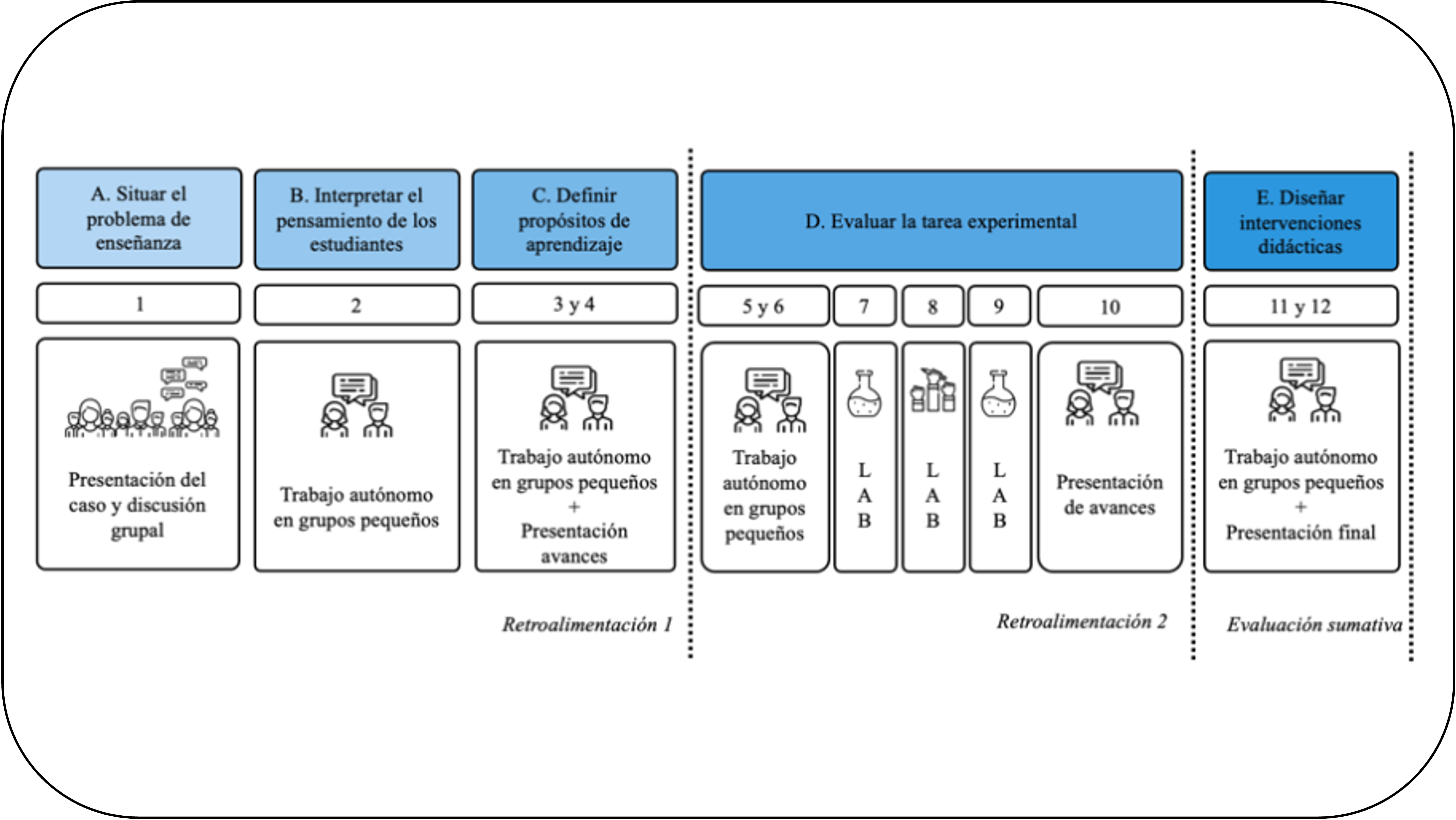
This article systematizes a instructional proposal aimed at developing pedagogical content knowledge in the initial education of chemistry teachers, implemented over a decade in a Chilean university. The proposal is organized around two articulated pillars: co-teaching between disciplinary and didactic specialists, and the analysis of authentic teaching cases with a high disciplinary component. Through iterative instructional cycles, future teachers interpret student thinking, define learning goals and design situated didactic interventions, critically integrating disciplinary, curricular, didactic and pedagogical knowledge for responsive teaching. The authentic cases act as situated reflection devices, linking the analysis of disciplinary content with informed pedagogical decision-making. The results show transformations in the way prospective teachers articulate theory and practice, and in their ability to think about teaching from a professionalized perspective. The contributions and challenges of the proposal are discussed, highlighting its potential to strengthen the initial education of science teachers through the deliberate integration of disciplinary and didactic knowledge.Keywords

Downloads
How to Cite
License

This work is licensed under a Creative Commons Attribution-NonCommercial 4.0 International License.
Require authors to agree to Copyright Notice as part of the submission process. This allow the / o authors / is non-commercial use of the work, including the right to place it in an open access archive. In addition, Creative Commons is available on flexible copyright licenses (Creative Commons).

Reconocimiento-NoComercial
CC BY-NC
References
Abell, S. K. (2008). Twenty years later: Does pedagogical content knowledge remain a useful idea? International Journal of Science Education, 30(10), 1405–1416. https://doi.org/10.1080/09500690802187041
Bacharach, N., Heck, T. y Dahlberg, K. (2010). Changing the face of student teaching through co-teaching. Action in Teacher Education, 32(1), 3–14. https://doi.org/10.1080/01626620.2010.10463538
Baeten, M. y Simons, M. (2014). Student teachers’ team teaching: Models, effects, and conditions for implementation. Teaching and Teacher Education, 41, 92–110. https://doi.org/10.1016/j.tate.2014.03.010
Behling, F., Förtsch, C. y Neuhaus, B. J. (2022). The refined consensus model of pedagogical content knowledge (PCK): Detecting filters between the realms of PCK. Education Sciences, 12(9), Article 592. https://doi.org/10.3390/educsci12090592
Berry, A., Friedrichsen, P. y Loughran, J. (Eds.). (2015). Re-examining pedagogical content knowledge in science education. Routledge.
Carlson, J., Daehler, K. R., Alonzo, A. C., Barendsen, E., Berry, A., Borowski, A., Carpendale, J., Kam, K., Cooper, R., Friedrichsen, P., Gess-Newsome, J., Henze-Roetvelt, I., Hume, A., Kirschner, S., Liepertz, S., Loughran, J., Mavhunga, E., Neumann, K., Nilsson, P., Park, S., Rollnick, M., Sickel, A., Schneider, R., Kjung, J., Van Driel, J. y Wilson, C. D. (2019). The refined consensus model of pedagogical content knowledge in science education. En A. Berry, P. Friedrichsen y J. Loughran (Eds.), Repositioning pedagogical content knowledge in teachers’ knowledge for teaching science (pp. 77–94). Springer. https://doi.org/10.1007/978-981-13-5898-2_5
Darling-Hammond, L. y Snyder, J. (2000). Authentic assessment of teaching in context. Teaching and Teacher Education, 16(5–6), 523–545. https://doi.org/10.1016/S0742-051X(00)00015-9
DeCoito, I. y Fazio, X. (2016). Developing case studies in teacher education: Spotlighting socioscientific issues. Innovations in Science Teacher Education, 2(1).
Delgado, V., Marzabal, A. y Moreno, J. (2023). Las ideas alternativas de los estudiantes sobre la cinética de las reacciones químicas. Alambique: Didáctica de las Ciencias Experimentales, (111), 26–31.
Dubek, M. y Doyle-Jones, C. (2021). Faculty co-teaching with their teacher candidates in the field: Co-planning, co-instructing, and co-reflecting for STEM education teacher preparation. The Teacher Educator, 56(4), 445–465. https://doi.org/10.1080/08878730.2021.1909652
Ferrés, C., Marbà, A. y Sanmartí, N. (2015). Trabajos de indagación de los alumnos: Instrumentos de evaluación e identificación de dificultades. Revista Eureka sobre Enseñanza y Divulgación de las Ciencias, 12(1), 22–37.
Friedrichsen, P., Van Driel, J. H. y Abell, S. K. (2009). Taking a closer look at science teaching orientations. Science Education, 93(4), 358–376. https://doi.org/10.1002/sce.20303
Friend, M. y Cook, L. (2010). Interactions: Collaboration skills for school professionals. Pearson.
Günther, S. L., Fleige, J., zu Belzen, A. U. y Krüger, D. (2019). Using the case method to foster preservice biology teachers’ content knowledge and pedagogical content knowledge related to models and modeling. Journal of Science Teacher Education, 30(4), 321–343. https://doi.org/10.1080/1046560X.2018.1560208
Gess-Newsome, J. (2015). A model of teacher professional knowledge and skill including PCK: Results of the thinking from the PCK Summit. En A. Berry, P. Friedrichsen y J. Loughran (Eds.), Re-examining pedagogical content knowledge in science education (pp. 28–42). Routledge.
Justi, R. y Van Driel, J. (2005). A case study of the development of a beginning chemistry teacher’s knowledge about models and modelling. Research in Science Education, 35, 197–219. https://doi.org/10.1007/s11165-004-7583-z
Kind, V. (2009). Pedagogical content knowledge in science education: Perspectives and potential for progress. Studies in Science Education, 45(2), 169–204. https://doi.org/10.1080/03057260903142285
Kind, V. y Chan, K. K. (2019). Resolving the amalgam: Connecting pedagogical content knowledge, content knowledge and pedagogical knowledge. International Journal of Science Education, 41(7), 964–978. https://doi.org/10.1080/09500693.2019.1584931
Levin, D., Hammer, D. y Coffey, J. E. (2009). Novice teachers’ attention to student thinking. Journal of Teacher Education, 60(2), 142–154. https://doi.org/10.1177/0022487108330245
Loughran, J. (2019). Pedagogical reasoning: The foundation of the professional knowledge of teaching. Teachers and Teaching, 25(5), 523–535. https://doi.org/10.1080/13540602.2019.1633294
Magnusson, S., Krajcik, J. y Borko, H. (1999). Nature, sources, and development of pedagogical content knowledge. En J. Gess-Newsome y N. G. Lederman (Eds.), Examining pedagogical content knowledge (pp. 95–132). Springer.
Marzabal, A., Moreira, P., Delgado, V., Moreno, J. y Contreras, R. (2016). Hacia la integración del conocimiento disciplinar y pedagógico: Desarrollando el conocimiento pedagógico del contenido en la formación inicial de profesores de química. Estudios Pedagógicos (Valdivia), 42(4), 243–260.
Murphy, C. y Martin, S. N. (2015). Coteaching in teacher education: Research and practice. Asia-Pacific Journal of Teacher Education, 43(4), 277–280. https://doi.org/10.1080/1359866X.2015.1066807
Park, S. y Chen, Y. C. (2012). Mapping out the integration of the components of PCK: Examples from high school biology classrooms. Journal of Research in Science Teaching, 49(7), 922–941. https://doi.org/10.1002/tea.21022
Park, S. y Oliver, J. S. (2008). Revisiting the conceptualisation of pedagogical content knowledge (PCK): PCK as a conceptual tool to understand teachers as professionals. Research in Science Education, 38(3), 261–284. https://doi.org/10.1007/s11165-007-9049-6
Richards, J. y Robertson, A. D. (2015). A review of the research on responsive teaching in science and mathematics. Taylor & Francis.
Shulman, L. S. (1986). Those who understand: Knowledge growth in teaching. Educational Researcher, 15(2), 4–14. https://doi.org/10.3102/0013189X015002004
Traiman-Schroh, N., Raviolo, A. y Farré, A. (2022). Dificultades en el aprendizaje del concepto concentración: Una metasíntesis. Educación Química, 33(3), 127–138. https://doi.org/10.22201/fq.18708404e.2022.3.81066
Van Driel, J. H., Hume, A. y Berry, A. (2023). Research on science teacher knowledge and its development. En Handbook of research on science education (pp. 1123–1161). Routledge.
Vázquez-Bernal, B., Mellado, V. y Jiménez-Pérez, R. (2022). The long road to shared PCK: A science teacher’s personal journey. Research in Science Education, 52(6), 1807–1828. https://doi.org/10.1007/s11165-021-10005-1
Weinberg, A. E., Sebald, A., Stevenson, C. A. y Wakefield, W. (2020). Toward conceptual clarity: A scoping review of coteaching in teacher education. The Teacher Educator, 55(2), 190–213. https://doi.org/10.1080/08878730.2019.1657214
Yee, S. F. (2019). A phenomenological inquiry into science teachers’ case method learning. Springer.