
Teachers' discursive movements in the modelling-oriented science classroom
DOI
https://doi.org/10.25267/Rev_Eureka_ensen_divulg_cienc.2026.v23.i1.1103Info




Authors
- Alba Cortés-Morales (CL) Pontificia Universidad Católica de Chile https://orcid.org/0000-0002-3804-7942
- Ainoa Marzabal (CL) Pontificia Universidad Católica de Chile https://orcid.org/0000-0003-0108-5889
- Digna Couso (ES) Universitat Autónoma de Barcelona

Abstract
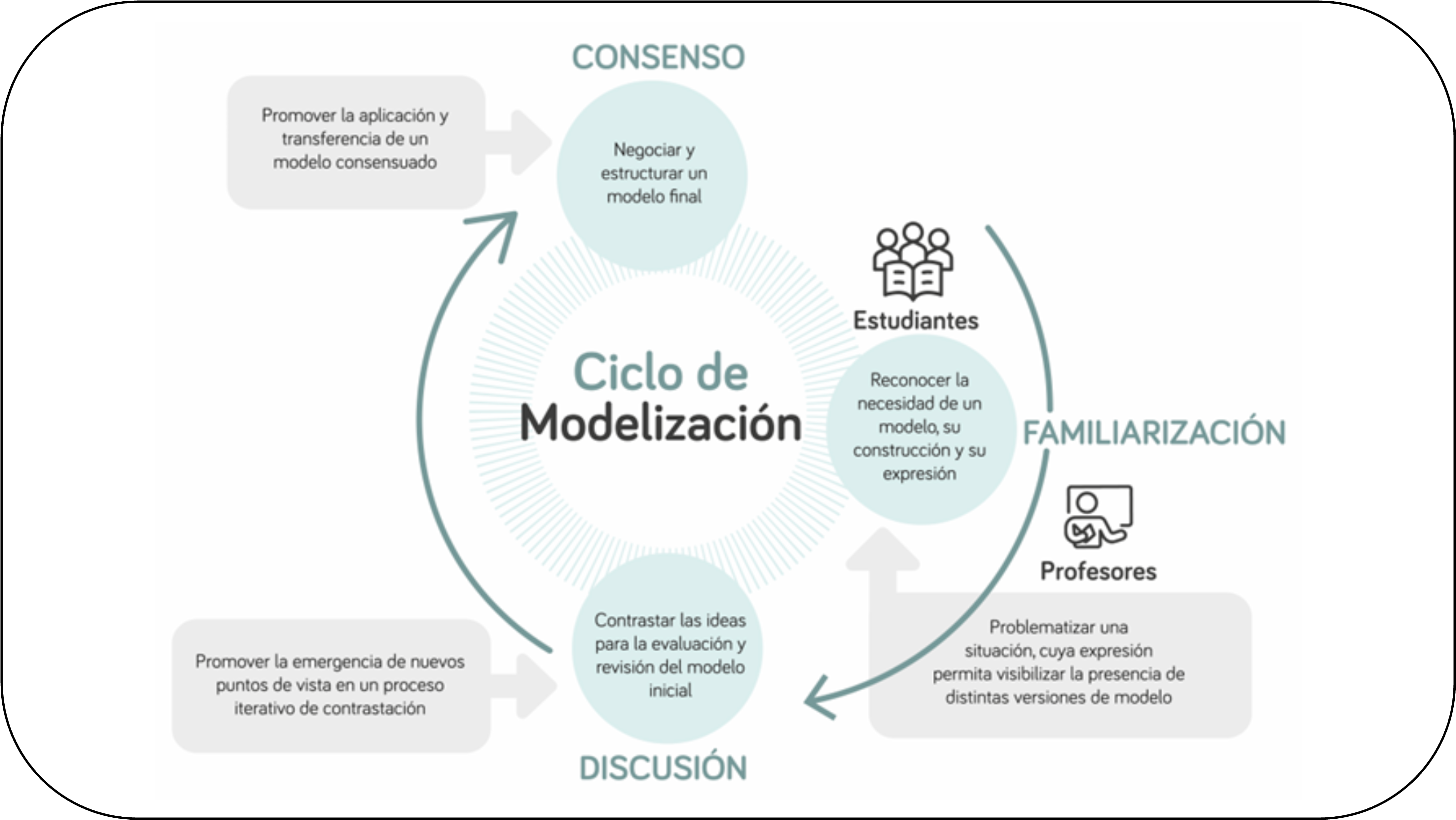
This research explores science teachers' discursive practices in science modelling contexts, with an emphasis on discursive decision-making in the classroom and its effects on students' learning opportunities. To analyse these discursive processes, teachers' turns of speech when implementing tasks with modelling potential are characterised by means of a discourse analysis that includes the breakdown of dialogue according to their instructional modelling intention (familiarisation, discussion and consensus), as well as the classification of the types of modelling-oriented discursive interactions (validation, information, clarification, questioning and consolidation) of three chemistry teachers implementing the same task with low modelling potential. The results show the repertoire of linguistic movements used by teachers in the classroom that could serve as modelling-based and suggest the importance of teacher discourse in modifying (maintaining, improving or reducing) the modelling potential of the tasks they implement in the classroom.
Keywords

Downloads
Supporting Agencies
How to Cite
License
Copyright (c) 2025 Alba Cortés-Morales, Ainoa Marzabal, Digna Couso

This work is licensed under a Creative Commons Attribution-NonCommercial 4.0 International License.
Require authors to agree to Copyright Notice as part of the submission process. This allow the / o authors / is non-commercial use of the work, including the right to place it in an open access archive. In addition, Creative Commons is available on flexible copyright licenses (Creative Commons).

Reconocimiento-NoComercial
CC BY-NC
References
Alexander, R. (2018). Towards dialogic teaching: Rethinking classroom talk.
Armario-Bernal, M., Jiménez-Tenorio, N. y Oliva, J. M. (2021). La interpretación del fenómeno de las mareas como foco para el diseño de una propuesta didáctica. Revista Eureka sobre Enseñanza y Divulgación de las Ciencias, 18(3). https://doi.org/10.25267/Rev_Eureka_ensen_divulg_cienc.2021.v18.i3.3802
Buty, C. y Mortimer, E. F. (2008). Dialogic/authoritative discourse and modelling in a high school teaching sequence on optics. International Journal of Science Education, 30(12), 1635–1660. https://doi.org/10.1080/09500690701466280
Cortés-Morales, A. y Marzabal, A. (2025). The design of science teaching and learning tasks with modelling potential. Studies in Science Education, 1–29. https://doi.org/10.1080/03057267.2025.2493990
Chin, C. (2007). Teacher questioning in science classrooms: Approaches that stimulate productive thinking. Journal of Research in Science Teaching, 44(6), 815–843. https://doi.org/10.1002/tea.20171
Garrido, A. y Couso, D. (2024). The IPM cycle: An instructional tool for promoting students’ engagement in modeling practices and construction of models. Journal of Research in Science Teaching. https://doi.org/10.1002/tea.21979
Garrido Espeja, A., Soto Alvarado, M. y Couso Lagarón, D. (2022). Formación inicial de docentes de ciencia: Posibles aportes y tensiones que brinda la modelización. Enseñanza de las Ciencias, 40(1), 87–105.
Gilbert, J. y Justi, R. (2016). Modelling-based teaching in science education.
Göhner, M. F., Bielik, T. y Krell, M. (2022). Investigating the dimensions of modeling competence among preservice science teachers: Meta-modeling knowledge, modeling practice, and modeling product. Journal of Research in Science Teaching, 59(8), 1354–1387. https://doi.org/10.1002/tea.21759
Hennessy, S., Rojas-Drummond, S., Higham, R., Márquez, A. M., Maine, F., Ríos, R. M., García-Carrión, R., Torreblanca, O. y Barrera, M. J. (2016). Developing a coding scheme for analysing classroom dialogue across educational contexts. Learning, Culture and Social Interaction, 9, 16–44. https://doi.org/10.1016/j.lcsi.2015.12.001
Jiménez Liso, M. R., Martínez Chico, M. y López-Gay Lucio-Villegas, R. (2023). Cómo enseñar a diseñar Secuencias de Actividades de Ciencias: Principios, elementos y herramientas de diseño. Revista Eureka sobre Enseñanza y Divulgación de las Ciencias, 20(3), 3801. https://doi.org/10.25267/rev_eureka_ensen_divulg_cienc.2023.v20.i3.3801
Johnstone, B. (2000). Reading and listening: Discourse analysis. In Qualitative Methods in Sociolinguistics (pp. 103–129). Oxford University Press.
Krist, C., Machaka, N., Voss, D., Mathayas, N., Kelly, S. y Shim, S. (2023). Teacher noticing for supporting students’ epistemic agency in science sensemaking discussions. Journal of Science Teacher Education, 1–21. https://doi.org/10.1080/1046560X.2022.2155355
Lehesvuori, S., Ramnarain, U. y Viiri, J. (2018). Challenging transmission modes of teaching in science classrooms: Enhancing learner-centredness through dialogicity. Research in Science Education, 48(5), 1049–1069. https://doi.org/10.1007/s11165-016-9598-7
Louca, L. T. y Zacharia, Z. C. (2012). Modeling-based learning in science education: Cognitive, metacognitive, social, material and epistemological contributions. Educational Review, 64(4), 471–492. https://doi.org/10.1080/00131911.2011.628748
Nurkka, N., Viiri, J., Littleton, K. y Lehesvuori, S. (2014). A methodological approach to exploring the rhythm of classroom discourse in a cumulative frame in science teaching. Learning, Culture and Social Interaction, 3(1), 54–63. https://doi.org/10.1016/j.lcsi.2014.01.002
Marzabal, A., Merino, C., Soto, M. y Cortés-Morales, A. (2024). Modeling-based science education. En Rethinking Science Education in Latin America (Vol. 59). https://doi.org/10.1007/978-3-031-52830-9_13
Matthews, M. R. (2014). Science teaching: The contribution of history and philosophy of science (20th anniversary revised and expanded ed.). Routledge.
Merino, C. y Izquierdo, M. (2011). Aportes a la modelización según el cambio químico. Educación Química, 22(3), 212–223. https://doi.org/10.1016/s0187-893x(18)30137-x
Michaels, S. y O’Connor, C. (2015). Conceptualizing talk moves as tools: Professional development approaches for academically productive discussions. EnSocializing Intelligence Through Academic Talk and Dialogue (pp. 333–347).
Nennig, H. T., States, N. E., Macrie-Shuck, M., Fateh, S., Gunes, Z. D. K., Cole, R., Rushton, G. T., Shah, L. y Talanquer, V. (2023). Exploring social and cognitive engagement in small groups through a community of learners lens. Chemistry Education Research and Practice, 24(3), 1077–1099. https://doi.org/10.1039/d3rp00071k
Nielsen, S. S. y Nielsen, J. A. (2021). A competence-oriented approach to models and modelling in lower secondary science education. Research in Science Education, 51, 565–593. https://doi.org/10.1007/s11165-019-09900-1
Oh, P. S., Ha, H. y Yoo, Y. J. (2022). Epistemological messages in a modeling-based elementary science classroom compared with a traditional classroom. Science Education. https://doi.org/10.1002/sce.21724
Oliva, J. M. (2019). Distintas acepciones para la idea de modelización en la enseñanza de las ciencias. Enseñanza de las Ciencias, 37(2), 5–24. https://doi.org/10.5565/rev/ensciencias.2648
Park, B.-Y., Campbell, T., Kelly, M., Gray, R., Arnold, C., Chadwick, C., Cisneros, L. M., … y Willig, M. R. (2021). Improving NGSS focused model-based learning curriculum through the examination of students’ experiences and iterated models. Research in Science and Technological Education, 1–25. https://doi.org/10.1080/02635143.2021.1978962
Russ, R. S. (2018). Characterizing teacher attention to student thinking: A role for epistemological messages. Journal of Research in Science Teaching, 55(1), 94–120. https://doi.org/10.1002/tea.21414
Schwarz, C. V., Ke, L., Salgado, M. y Manz, E. (2022). Beyond assessing knowledge about models and modeling: Moving toward expansive, meaningful, and equitable modeling practice. Journal of Research in Science Teaching, 1–11. https://doi.org/10.1002/tea.21770
Scott, P., Mortimer, E. y Aguiar, O. (2006). The tension between authoritative and dialogic discourse. Science Education, 90(4), 605–631. https://doi.org/10.1002/sce.20131
Šeďová, K., Šalamounová, Z., Švaříček, R. y Sedláček, M. (2020). Getting dialogic teaching into classrooms. Springer.
Šeďová, K., Sedlacek, M. y Svaricek, R. (2016). Teacher professional development as a means of transforming student classroom talk. Teaching and Teacher Education, 57, 14–25. https://doi.org/10.1016/j.tate.2016.03.005
Soysal, Y. (2019). Indicators of productive classroom talk and supporting discourse moves. Academy Journal of Educational Sciences, 3(2), 114–137. https://doi.org/10.31805/acjes.642246
Tekkumru-Kisa, M., Stein, M. K. y Schunn, C. (2015). A framework for analyzing cognitive demand and content-practices integration. Journal of Research in Science Teaching, 52(5), 659–685. https://doi.org/10.1002/tea.21208
Téllez-Acosta, M. E., McDonald, S. y Acher, A. (2023). Sociocultural ways of conceptualizing professional vision. International Journal of Science Education, 1–21. https://doi.org/10.1080/09500693.2023.2290602
Tena, È. y Couso, D. (2023). ¿Cómo sé que mi secuencia didáctica es de calidad? Revista Eureka sobre Enseñanza y Divulgación de las Ciencias, 20(2), 2801. https://doi.org/10.25267/Rev_Eureka_ensen_divulg_cienc.2023.v20.i2.2801
Tytler, R. y Aranda, G. (2015). Expert teachers’ discursive moves in science classroom interactive talk. International Journal of Science and Mathematics Education, 13(2), 425–446. https://doi.org/10.1007/s10763-015-9617-6
van der Veen, C., de Mey, L., van Kruistum, C. y van Oers, B. (2017). The effect of productive classroom talk and metacommunication on children’s communicative competence. Learning and Instruction, 48, 14–22. https://doi.org/10.1016/j.learninstruc.2016.06.001
Vergara, C., López-Simó, V. y Couso, D. (2025a). El ciclo de modelización a través de la interacción oral. Revista Eureka sobre Enseñanza y Divulgación de las Ciencias, 22(2), 2301. https://doi.org/10.25267/Rev_Eureka_ensen_divulg_cienc.2025.v22.i2.2301
Vergara, C., López-Simó, V. y Couso-Lagarón, D. (2025b). Dialogar en un aula para construir ideas científicas. Ápice. Revista de Educación Científica, 9(1), 21–38. https://doi.org/10.17979/arec.2025.9.1.11311
Vo, T., Forbes, C., Zangori, L. y Schwarz, C. V. (2019). Longitudinal investigation of inservice teachers’ modelling of hydrological phenomena. International Journal of Science Education, 41(18), 2788–2807. https://doi.org/10.1080/09500693.2019.1698786
Wade-Jaimes, K., Demir, K. y Qureshi, A. (2018). Modeling strategies enhanced by metacognitive tools. Science Education, 102(4), 711–743. https://doi.org/10.1002/sce.21444
Windschitl, M., Thompson, J. y Braaten, M. (2008). Beyond the scientific method: Model-based inquiry. Science Education, 92(5), 941–967. https://doi.org/10.1002/sce.2025