
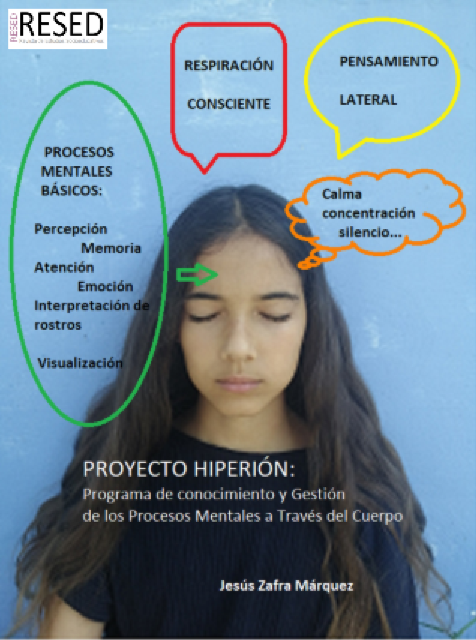
Proyecto Hiperión: Programa de conocimiento y gestión de los procesos mentales a través del cuerpo
Información
Autores/as
- Jesus Zafra Márquez (ES)

Resumen
En el presente artículo damos a conocer el Proyecto Hiperión, desde sus elementos básicos hasta su implementación en estudiantes de enseñanza secundaria y bachillerato de la provincia de Cádiz. Este proyecto de innovación docente nace a partir del estudio de contenidos procedentes de la neurociencia y el yoga, con el objetivo de iniciar a los jóvenes en el conocimiento y gestión de algunos de los procesos mentales básicos. Creemos que la mejor forma de favorecer el crecimiento y la evolución personales es a través del desarrollo de la sensibilidad, la atención y la capacidad de observación de nuestra actividad mental. Hacemos también referencia a los principios teóricos que sustentan esta propuesta innovadora y las perspectivas de futuro que se presentan a partir del trabajo realizado hasta el momento.
Palabras clave

Descargas
Cómo citar
Licencia

Esta obra está bajo una licencia internacional Creative Commons Atribución-NoComercial 4.0.
Citas
Barraza, A. (2005). Característica del estrés académico de los estudiantes de educación media superior. INED, (4), 15-20. Universidad Pedagógica de Durango.
Bayón, M. y Martínez, J. (2008). Plasticidad cerebral inducida por algunas terapias aplicadas en el paciente con ictus. Rehabilitación, Volume 42, Issue 2, 86-91
Broderick, P. C. (2013). Learning to BREATHE: A mindfulness curriculum for adolescents. Oakland, CA: New Harbinger.
Calero, J. (2007). Desigualdades socio-económicas en el sistema educativo español. Madrid, Centro de Investigación y Documentación Educativa- Ministerio de Educación.
Cea. J.I., Caso, R., Reyes del Paso, GA., González-Pinto, A., Brazal, J., Martinez, B. (2005). Blood pressure is reduced after a breathing intervention in mild hypertensive patients. Society for Psychophysiological Research 45th Annual Meeting: 2005 September 21-24: Lisboa, Portugal
Cea, J.I. (2005). Abordaje psicofisiológico de la hipertensión arterial esencial. [Tesis Doctoral]. Universidad País Vasco.
Cea, J.I., González-Pinto, A., Cabo, OM. (2010). Respiración controlada para reducir el estrés. Estudio preliminar de su eficacia sobre el cortisol. Rev ROL Enf. 2010; 33:368-74.
Conde, M., Menéndez, F.J., Santéd, M.A., Estrada, JD. (enero 1999). Incidencia de la frecuencia respiratoria en la conductancia eléctrica de la piel. Revista Electrónica de Motivación y Emoción. Disponible en: https://cutt.ly/Pt1RleI
Damasio, A. (2006). El Error de Descartes. Madrid, España: Crítica.
Davidson, Richard J. (2012). Contemplative Practices and Mental Training: Prospects for American Education. Child development perspectives, Volume 6, Number 2, 146–153.
Davidson, R. & McEwen, B. (2012). Social influences on neuroplasticity: stress and interventions to promote well-being. Nat Neurosci, volume 15 | number 5 | MAY 2012.
Davidson, R. (2012). El perfil emocional de tu cerebro. Madrid, España: Destino.
Davis, M. (1980). A multidimensional aproach to individual diferences in empathy. JSAS Catalog os Selected Documents in Psycology, 10: 1-19
De Bono, E. (1989). El Pensamiento Lateral. Manual de Creatividad. Buenos Aires, Argentina: Paidós.
De Bono, E. (1992). El pensamiento práctico. Barcelona: Paidós.
Ekman, P., Keltner, D. (2014). Darwin's Claim of Universals in Facial Expressions Not Challenged. Huffington Post.
Ekman, P., Cordaro, D. (2011). What is meant by calling emotions basic. Emotion Review, 3(4), 364-370.
Franco, Mañas y Justo. (2009). Reducción de los niveles de estrés, ansiedad y depresión en docentes de educación especial a través de un programa de mindfulness. Universidad de Almería. Revista Educación Inclusiva, Vol.2 nº3.
Gardner, M. (1985). Inspiración ¡Ajá!. Barcelona, España: Labor.
Hanson, Rachel. (2016). Yoga for Depression and Anxiety: A systematic review. Recuperado de Sophia, the St. Catherine University repository website: https://cutt.ly/pt1REol
Foray, D. y Lundvall, (1996). Employment and Growth in the Knowledge-Based Economy. Paris, France: B.A.
Golberg, E. (2002). El cerebro Ejecutivo. Madrid, España: Crítica.
Horkheimer, M. y Adorno, T. (2007). Dialéctica de la Ilustración. Madrid, España: Akal.
James, W. (1994). Principios de psicología. USA: Fondo de Cultura Económica.
Jensen, E. (2004). Cerebro y Aprendizaje: competencias e implicaciones educativas. Madrid, España: Narcea.
López González, L. (2016). Competencias de Relajación, Meditación y Mindfulness en la Escuela. Una propuesta de concreción. Universidad de Barcelona: ICE (prensa)
Maturana, A., Vargas, A. (2015). El estrés escolar. Revista Médica Clínica Las Condes, Volume 26, Issue 1, January.FebruaryPages 34-41.
Martínez-Otero Pérez, V. (2007). Estrés y ansiedad en los Docentes. Pulso. 20. 9-21.
Ma X, Yue Z-Q, Gong Z-Q, Zhang H, Duan N-Y, Shi Y-T, Wei G-X and Li Y-F. (2017). The Effect of Diaphragmatic Breathing on Attention, Negative Affect and Stress in Healthy Adults. Front. Psychol. 8:874. doi:10.3389/fpsyg.2017.00874. Recuperado de University repository website: https://cutt.ly/Rt1RIRs
Merleau-Ponty, M. (1985). Fenomenología de la Percepción. Barcelona, España: Planeta de Agostini.
Nietzsche, F. (1997). El crepúsculo de los ídolos. Madrid, España: Alianza.
Ortega y Gasset, José. (2012). El tema de nuestro tiempo. Obras completas. Vol. III. Madrid, España: Taurus.
Pascual-Leone, A., Sadato, J., Grafman, Ibañez, V. Deiber, NP., Dold, G. (1996). Activation of the primary visual cortex by Braille reading in blind subjects. Nature 380 (6574), 526-528.
Pascual-Leone, F. (1993). Plasticity of the sensorimotor cortex representation of the reading finger in Braille readers, Brain 116 (1).
Posner, M., Petersen, S. (1990). The attention system of the human brain. Annual Reviews of Neuroscience. 35, 73-89. https://dx.doi.org/10.1146 / annurev-neuro-062111-150525
Pert, C. (1999). The molecules of Emotion. New York: Touchtone Editions.
Ramachandran, V. S, (2012). Lo que el cerebro nos dice. Barcelona, España: Paidos.
Ramachndran, V. S. (2008). Laberintos del Cerebro. Barcelona, España: La Liebre de Marzo.
Ravinder, Braun, Barnes, Harden (2015). Self-Regulation of Breathing as a Primary Treatment for Anxiety. Revista Applied Psychophysiology and Biofeedback. 40 (2): 107-115
Ruiz Lázaro, PJ (2016). Mindfulness en niños y adolescentes. En: AEPap (ed.). Curso de Actualización Pediatría 2016. Madrid: Lúa Ediciones 3.0; pág. 487-501.
Sacks, O. (2006). Un antropólogo en Marte. Barcelona, España: Anagrama.
Satyananda, S (1966). Asana, Pranayama, Mudra, Bhanda. Munger, Bihar, India: Yoga Publications Trust.