
Educational Robotics in support of creative thinking: A case study in rural primary school classrooms
Downloads
- PDF (Español (España)) 159
- EPUB (Español (España)) 5
- VISOR (Español (España))
- MÓVIL (Español (España))
- XML (Español (España)) 4
DOI
https://doi.org/10.25267/Rev_Eureka_ensen_divulg_cienc.2026.v23.i1.1201Info




Authors
- Maria Obdulia Gonzalez Fernández (MX) Universidad de Guadalajara https://orcid.org/0000-0001-5890-7666
- Cesar Aceves Aldrete (MX) Universidad de Guadalajara https://orcid.org/0000-0001-7531-7051
- Ana Belen Perez-Torregrosa (ES) Universidad de Jaen https://orcid.org/0000-0002-3428-6348
- Horacio Gómez Rodríguez (MX) University of Guadalajara https://orcid.org/0000-0003-0300-1749

Abstract
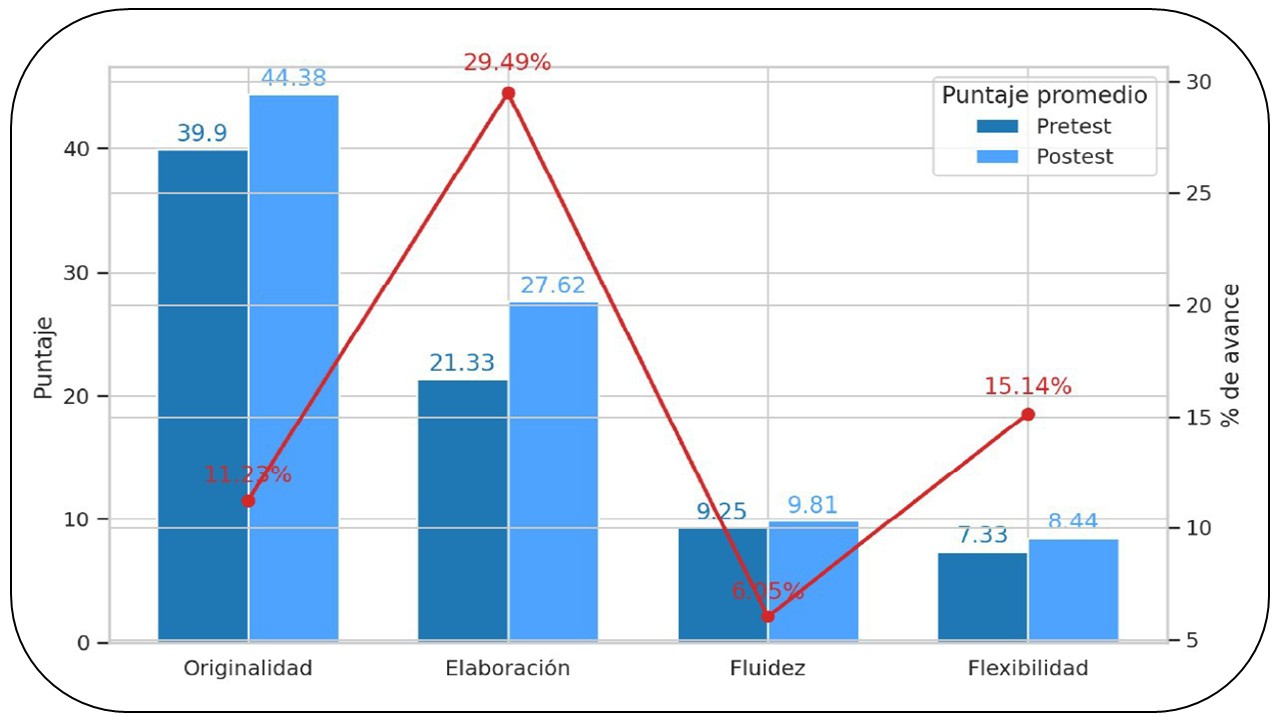
Educational robotics is an alternative for bringing STEAM learning to students in rural areas with limited access to technology. This study describes the results of a robotics workshop using mBot, designed to measure the creativity of 9-12 year old students in a multi-grade rural school setting. A case study was designed using a pre-test/post-test design. The Torrance Tests of Creative Thinking were used as the data collection instrument. The findings show an increase in creative thinking, primarily in the elaboration component. The study highlights the relationship with STEAM learning, suggesting that integrating robotics in rural contexts can be an alternative for promoting science learning. One limitation identified was the sample size, meaning the results cannot be generalized. In conclusion, this study underscores the importance of using robotics in basic education as an innovative strategy to promote creative thinking and its connection to problem-solving through challenges.
Keywords

Downloads
Supporting Agencies
How to Cite
License
Copyright (c) 2025 Maria Obdulia Gonzalez Fernández, Cesar Eduardo Aceves Aldrete, Ana Belén Pérez-Torregrosa, Horacio Gómez Rodríguez

This work is licensed under a Creative Commons Attribution-NonCommercial 4.0 International License.
Require authors to agree to Copyright Notice as part of the submission process. This allow the / o authors / is non-commercial use of the work, including the right to place it in an open access archive. In addition, Creative Commons is available on flexible copyright licenses (Creative Commons).

Reconocimiento-NoComercial
CC BY-NC
References
Alabbasi, A., Paek, S., Kim, D. y Cramond, B. (2022). What do educators need to know about the Torrance Tests of Creative Thinking: A comprehensive review. Frontiers in Psychology, 13. https://doi.org/10.3389/fpsyg.2022.1000385
Alam, A. (2022). Educational Robotics and Computer Programming in Early Childhood Education: A Conceptual Framework for Assessing Elementary School Students’ Computational Thinking for Designing Powerful Educational Scenarios. 2022 International Conference on Smart Technologies and Systems for Next Generation Computing (ICSTSN), 1-7. https://doi.org/10.1109/ICSTSN53084.2022.9761354
Anik, M. H. y Romero, M. (2024). Comparative analysis of creative problem-solving tasks across age groups using modular cube robotics. Frontiers in Robotics and AI, 11, 1- 13. https://doi.org/10.3389/frobt.2024.1497511
Arrigui Torres, E. y Mosquera, J. (2022). Aportes de la educación STEAM. Revista Latinoamericana de Educación Científica, Crítica y Emancipadora (LadECiN), 1(1), 46-61. https://revistaladecin.com/index.php/LadECiN/article/view/40/2
Barradas, R., Lencastre, J., Soares, S. y Valente, A. (2024). Arduino-Based Mobile Robotics for Fostering Computational Thinking Development: An Empirical Study with Elementary School Students Using Problem-Based Learning Across Europe. Robotics, 13, 159. https://doi.org/10.3390/robotics13110159
Barria, C., Burbano, C. L., Cuellar Anturi, C. W., Draco, D. F. y Ortiz, W. F. (2020). Introducción a la robótica educativa en zonas rurales para la elaboración de un detector de obstáculos controlado mediante una app móvil. I+T+C, 25, 25-33. https://doi.org/10.57173/ritc.v1n14a3
Casado Fernández, R. y Checa Romero, M. (2020). Robótica y Proyectos STEAM: Desarrollo de la creatividad en las aulas de Educación Primaria. Píxel-Bit: Revista de Medios y Educación, (58), 51-69. https://doi.org/10.12795/pixelbit.73672
Casado Fernández, R. y Checa Romero, M. (2023). Creatividad, pensamiento crítico y trabajo en equipo en educación primaria: un enfoque interdisciplinar a través de proyectos STEAM. Revista complutense de educación, 34(3), 629-640. https://doi.org/10.5209/rced.79861
Castro, A., Medina, J., Aguilera-Carrasco, C., Ramirez, M. y Aguilera, C. (2022). Robotics Education in STEM Units: Breaking Down Barriers in Rural Multigrade Schools. Sensors, 23(1), 387. https://doi.org/10.3390/s23010387
Coufal, P. (2022). Project-Based STEM Learning Using Educational Robotics as the Development of Student Problem-Solving Competence. Mathematics, 10(23), 4618. https://doi.org/10.3390/math10234618
Díaz Barriga, Á. (2013). Tic en el trabajo del aula. Impacto en la planeación didáctica. Revista Iberoamericana de Educación Superior, 4(10), 3-21. https://www.redalyc.org/articulo.oa?id=299128588003
Eguchi, A. (2014). Educational Robotics for Promoting 21st Century Skills. Journal of Automation Mobile Robotics and Intelligent Systems, 8, 5–11. https://doi.org/10.14313/JAMRIS_1-2014/1
Eteokleous, N. (2018). Employing Educational Robotics for the Development of Problem-Based Learning Skills. In M. Khosrow-Pour, D.B.A. (Ed.), Encyclopedia of Information Science and Technology, (pp. 2492-2502). IGI Global Scientific Publishing. https://doi.org/10.4018/978-1-5225-2255-3.ch217
Faria De Souza, V., Manica, E., Hoff Lavarda, R. y Rios da Rocha, T. (2021). Educational Robotics in Science Teaching. International Journal for Innovation Education and Research 9(9), 262-273. https://doi.org/10.31686/ijier.vol9.iss9.3337
Fernández Morales, C., Iriarte Gómez, F., Mejía Solano, C. y Revuelta Domínguez, F. (2018). Contextualización de la formación virtual en robótica educativa de los docentes rurales del Perú. REXE. Revista de Estudios y Experiencias en Educación, 2(2), 70-84. https://doi.org/10.21703/rexe.Especial3201871826
González Fernández M. O., Flores González Y. A. y Muñoz López C. (2021). Panorama de la robótica educativa a favor del aprendizaje STEAM. Revista Eureka sobre Enseñanza y Divulgación de las Ciencias, 18(2), 2301. https://doi.org/10.25267/Rev_Eureka_ensen_divulg_cienc.2021.v18.i2.2301
González M.O. F. (2021). Ejemplo de actividades prácticas de robótica en el aula. González Fernández (Coord.), Robótica Educativa. Una perspectiva didáctica en el aula (pp. 87-110). Universidad de Guadalajara. http://repositorio.cualtos.udg.mx:8080/jspui/bitstream/123456789/1157/1/Libro_Robotica_interactivo.pdf
Gavrilas, L., Kotsis, K. T. y Papanikolaou, M. S. (2024). Exploration of the prospective utilization of educational robotics by preschool and primary education teachers. Pedagogical Research, 9(1), 1-8. https://doi.org/10.29333/pr/14049
Guilford, J. P. (1967). The nature of human intelligence. McGraw-Hill.
Guven, G., Kozcu Cakir, N., Sulun, Y., Cetin, G. y Guven, E. (2020). Arduino-assisted robotics coding applications integrated into the 5E learning model in science teaching. Journal of Research on Technology in Education, 54(1), 108-126. https://doi.org/10.1080/15391523.2020.1812136
Hernández, R. M. (2017). Impacto de las TIC en la educación: Retos y Perspectivas. Propósitos y Representaciones, 5(1), 325-347. https://doi.org/10.20511/pyr2017.v5n1.149
Hu, C., Yang, Y., Cheng, Y. y Chen, N. (2023). Integrating educational robot and low-cost self-made toys to enhance STEM learning performance for primary school students. Behaviour & Information Technology, 43, 1614-1635. https://doi.org/10.1080/0144929X.2023.2222308
Jaipal-Jamani, K. y Angeli, C. (2016). Effect of Robotics on Elementary Preservice Teachers’ Self-Efficacy, Science Learning, and Computational Thinking. Journal of Science Education and Technology, 26, 175-192. https://doi.org/10.1007/s10956-016-9663-z
Jiménez Castro, M. y Cerdas González, R. J. (2014). Educational robotics as promoting agent of the study, by the science and technology in the Atlantic region of Costa Rica. Congreso Iberoamericano de Ciencia, Tecnología, Innovación y Educación. https://goo.su/nQ73C
Jiménez González, J. E., Artiles Hernández, C., Rodríguez Rodríguez, C. y García Miranda, E. (2007). Adaptación y baremación del test de pensamiento creativo de Torrance: Expresión figurada. Educación Primaria y Secundaria. Consejería de Educación, Cultura y Deportes del Gobierno de Canarias, y Universidad de Las Palmas de Gran Canaria. https://goo.su/gUZSc6
Kelemen, G. (2017). Creativity, performance and emotional balance. Journal Plus Education, 18(2), 38-46. https://doi.org/10.24250/JPE/2/2017/KG
Kim, K. (2011). The APA 2009 División 10 Debate: Are the Torrance Tests of Creative Thinking Still Relevant in the 21st Century? Psychology of Aesthetics, Creativity, and the Arts, 5, 302-308. https://doi.org/10.1037/A0021917
Krumm, G. L., Filippetti, V. A., Lemos, V. N., Aranguren, M. y Rubilar, J. A. V. (2013). Invariancia de Medidas de la prueba de figuras del Test de Pensamiento Creativo de Torrance según la edad: Un estudio en niños y adolescentes de habla hispana. DOAJ. https://doaj.org/article/945a2cff46384419b02f5e86a8d9dec1
Larraz-Rábanos, N. (2021). Development of Creative Thinking Skills in the Teaching-Learning Process. In U. Kayapinar, Teacher Education - New Perspectives (pp. 307–322). IntechOpen. https://doi.org/10.5772/INTECHOPEN.97780
López Gamboa, M. V., Córdoba González, C. M. y Soto Soto, J. F. (2020). Educación STEM/STEAM: Modelos de implementación, estrategias didácticas y ambientes de aprendizaje que potencian las habilidades para el siglo XXI. Latin American Journal of Science Education, 7(1), 1-16. https://www.aacademica.org/marco.lopez/7
Morales Almeida, P. (2021). Uso de la robótica educativa como medio para favorecer la creatividad en la educación no formal. RIITE Revista Interuniversitaria de Investigación en Tecnología Educativa, 11, 85-97. https://doi.org/10.6018/riite.463631
Morales Valiente, C. (2017). The Creativity a Scientific Review. Arquitectura y Urbanismo, 38(2), 53-62. https://www.redalyc.org/pdf/3768/376852683005.pdf
Neira Castellanos, M. y Sánchez Morales, V. (2023). El enfoque STEM–STEAM en la educación científica: tendencias y perspectivas en publicaciones especializadas: una mirada desde ciencia, arte y tecnología. [Tesis Programa de Licenciatura en Química, Universidad Pedagógica Nacional]. Repositorio de la tesis Universidad Pedagógica Nacional, Bogotá, Colombia. http://repository.pedagogica.edu.co/handle/20.500.12209/18439
Nemiro, J., Larriva, C. y Jawaharlal, M. (2017). Developing Creative Behavior in Elementary School Students with Robotics. Journal of Creative Behavior, 51, 70-90. https://doi.org/10.1002/JOCB.87
Noh, J. y Lee, J. (2019). Effects of robotics programming on the computational thinking and creativity of elementary school students. Educational Technology Research and Development, 68, 463-484. https://doi.org/10.1007/s11423-019-09708-w
Orhani, S. (2023). Mbot robot as part of project-based learning in stem. Cadernos de Educação Tecnologia e Sociedade, 16(4), 862-872. https://doi.org/10.14571/brajets
Sáez López, J. M. y Cózar Gutiérrez, R. (2017). Programación visual por bloques en Educación Primaria: Aprendiendo y creando contenidos en Ciencias Sociales 1. Revista Complutense de Educación, 28(2), 409-426. http://dx.doi.org/10.5209/rev_RCED.2017.v28.n2.49381
Sari, T. K., Al Muhdhar, M. H. I. y Sueb, S. (2024). Creative Thinking Skills at Public Senior High School 1 Belitang Oku Timur Regency South Sumatra. Bioscientist, 12(2), 1972. https://doi.org/10.33394/bioscientist.v12i2.12957
Soto Valera, R., Boumadan, M., Ortega Rodríguez, P. J. y Poyatos Dorado, C. (2023). La Inclusión de Proyectos de Innovación Educativa con base TIC en los centros de Educación Primaria, y su Impacto en el Rendimiento Académico del Alumnado. Revista Electrónica Interuniversitaria de Formación del Profesorado, 26(1), 41-53. https://doi.org/10.6018/reifop.545011
Torrance, E. R. (1990). Torrance Tests of Creative Thinking. Manual for scoring and interpreting results. Verbal, forms A and B. https://psycnet.apa.org/doiLanding?doi=10.1037/t05532-000
Vavassori Benitti, F. B. (2012). Exploring the educational potential of robotics in schools: A systematic review. Computers Education, 58(3), 978-988. https://doi.org/10.1016/j.compedu.2011.10.006
Yang, Y., Long, Y., Sun, D., Aalst, J. V. y Cheng, S. (2020). Fostering students’ creativity via educational robotics: An investigation of teachers’ pedagogical practices based on teacher interviews. British Journal of Educational Technology, 51(5), 1826-1842. https://doi.org/10.1111/bjet.12985
Yeşilyurt, E. (2020). Yaratıcılık ve Yaratıcı Düşünme: Tüm Boyut ve Paydaşlarıyla Kapsayıcı Bir Derleme Çalışması. International Journal of Society Researches, 15(25), 3874-3915. https://doi.org/10.26466/OPUS.662721
Yüksel, A. O., Atasoy, B. y Özdemir, S. (2025). Transformation of labor: Educational robotics coding in elementary schools for 21st century skills. Entertainment Computing, 52, 1-14. https://doi.org/10.1016/j.entcom.2024.100890