
Challenges in the conceptualization and measurement of scientific identity: Validation of the Scientific Identity Questionnaire
Info
Authors
- Radu Bogdan Toma (ES) Universidad de Burgos http://orcid.org/0000-0003-4846-7323
- Ana I. Muñoz Dominguez (ES) IES Vasco de la Zarza https://orcid.org/0000-0002-1806-8957
- Pedro J. Sánchez Gómez (ES) Universidad Complutense de Madrid https://orcid.org/0000-0003-2547-3077

Abstract
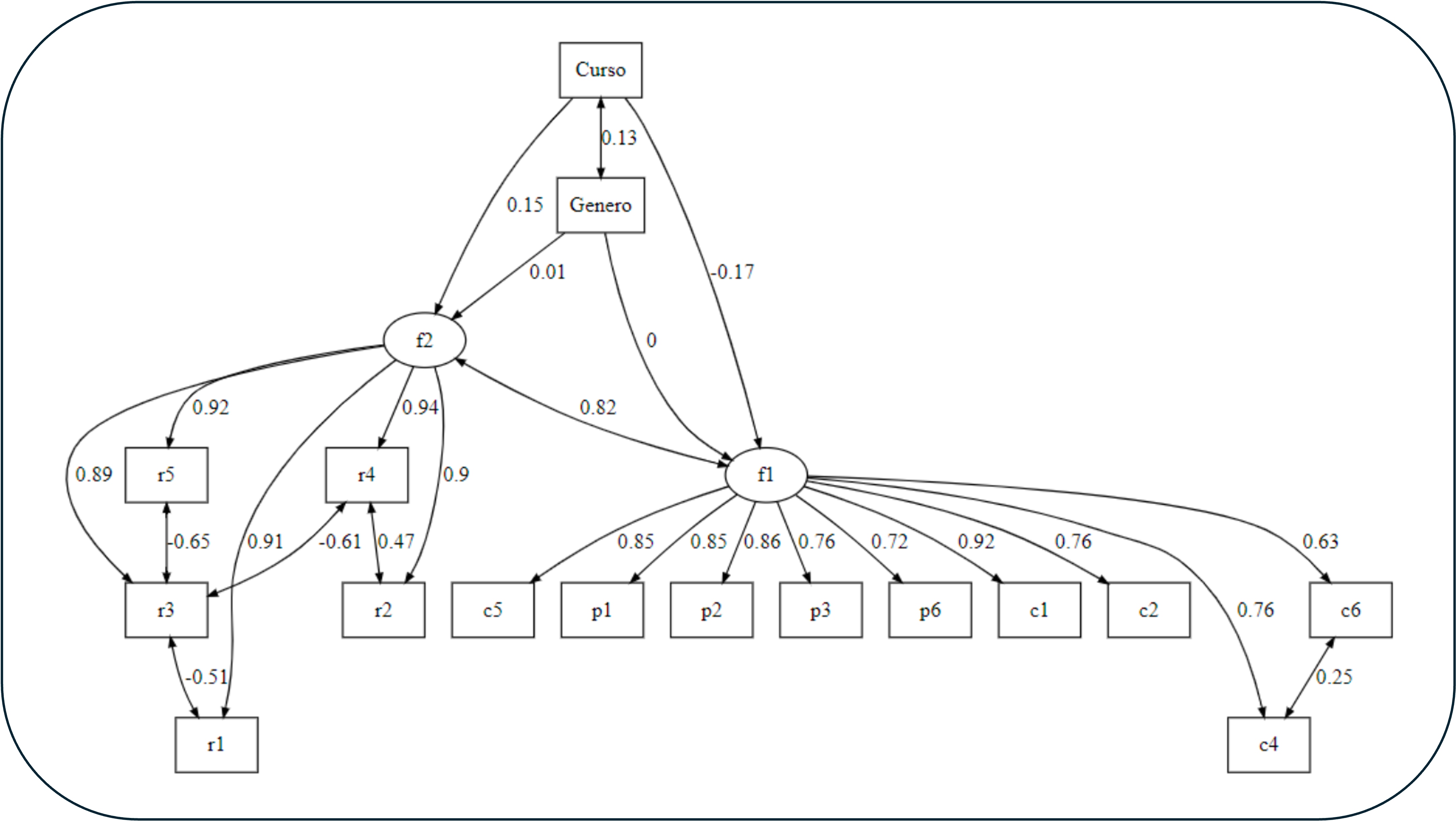
Research on scientific identity suffers from a lack of consensus in its conceptualization and measurement. This study validates the Spanish version of the Scientific Identity Questionnaire in a sample of secondary school students (N = 498). The results do not support the original four-factor model or other theoretical proposals from the literature. Instead, a two-factor model is proposed, comprising the constructs of "perceived performance/competence" and "recognition," with robust psychometric evidence in terms of structural, convergent, discriminant and concurrent validity, as well as high internal and test-retest reliability. Observed discrepancies are discussed, revealing methodological issues in previous studies that may have contributed to the proliferation of multiple constructs lacking theoretical grounding under the concept of scientific identity. The findings highlight the lack of consensus in the conceptualization of scientific identity and the need for greater methodological rigor in its assessment. In addition, this investigation provides a valid and reliable instrument for measuring this important construct in the Spanish-speaking populationKeywords

Downloads
Supporting Agencies
How to Cite
License

This work is licensed under a Creative Commons Attribution-NonCommercial 4.0 International License.
Require authors to agree to Copyright Notice as part of the submission process. This allow the / o authors / is non-commercial use of the work, including the right to place it in an open access archive. In addition, Creative Commons is available on flexible copyright licenses (Creative Commons).

Reconocimiento-NoComercial
CC BY-NC
References
American Educational Research Association [AERA], American Psychological Association [APA] y National Council on Measurement in Education [NCME]. (2014). Standards for Educational and Psychological Testing.
Archer, L., DeWitt, J., Osborne, J., Dillon, J., Willis, B. y Wong, B. (2010). “Doing” science ver-sus ‘being’ a scientist: examining 10/11-year-old schoolchildren’s constructions of science through the lens of identity. Science Education, 94(4), 617–639. https://doi.org/10.1002/sce.20399
Aschbacher, P. R., Li, E. y Roth, E. J. (2010). Is science me? High school students' identities, par-ticipation, and aspirations in science, engineering, and medicine. Journal of Research in Science Teaching, 47(5), 564–582. https://doi.org/10.1002/tea.20353
Bandura A., (1997). Self-efficacy: The exercise of control. New York, NY: Worth Publishers.
Barton, A. C. y Tan, E. (2010). We Be Burnin’! Agency, Identity, and Science Learning. Journal of the Learning Sciences, 19(2), 187–229. https://doi.org/10.1080/10508400903530044
Beaton, D. E., Bombardier, C., Guillemin, F. y Ferraz, M. B. (2000). Guidelines for the process of cross-cultural adaptation of self-report measures. Spine, 25(24), 3186–3191. https://doi.org/10.1097/00007632-200012150-00014
Brown, B., Reveles, J.M. y Kelly, G.J. (2005). Scientific literacy and discursive identity: A theo-retical framework for understanding science learning. Science Education, 89, 779–802. https://doi.org/10.1002/sce.20069
Brown, T. A. (2015). Confirmatory factor analysis for applied research. The Guilford Press.
Carlone, H. B. y Johnson, A. (2007). Understanding the science experiences of women of color: Science identity as an analytic lens. Journal of Research in Science Teaching, 44(8), 1187-1218. https://doi.org/10.1002/tea.20237
Chang, M. J., Eagan M. K., Lin M. H. y Hurtado S., (2011). Considering the impact of racial stigmas and science identity: Persistence among biomedical and behavioral science aspir-ants. The Journal of Higher Education, 82(5) 564–596. https://doi.org/10.1080/00221546.2011.11777218
Chemers, M. M., Zurbriggen E. L., Syed M., Goza B. K. y Bearman S. (2011). The role of effica-cy and identity in science career commitment among underrepresented minority students. Journal of Social Issues, 67(3), 469–491. https://doi.org/10.1111/j.1540-4560.2011.01710.x
Chen, S. y Wei, B. (2022). Development and validation of an instrument to measure high school students’ science identity in science learning. Research in Science Education, 52, 111–126. https://doi.org/10.1007/s11165-020-09932-y
Dongyao, T. y Yukiko, M. (2021) Perceptions of science teachers’ growth-mindset practices and U.S. high school students’ initial science identity and its development, International Jour-nal of Science Education, 43(13), 2206-2225. https://doi.org/10.1080/09500693.2021.1958021
Eccles, J. S. y Wigfield, A. (2023). Expectancy-value theory to situated expectancy-value theory: Reflections on the legacy of 40+ years of working together. Motivation Science, 9(1), 1-12. https://doi.org/10.1037/mot0000275
Estrada, M., Woodcock A., Hernandez P. R. y Schultz P. W., (2011). Toward a model of social influence that explains minority student integration into the scientific community, Journal of Educational Psychology, 103(1) 206-222. https://doi.org/10.1037/a0020743
Estrada, M., Hernandez P. R. y Schultz P. W., (2018). A longitudinal study of how quality men-torship and research experience integrate underrepresented minorities into STEM careers, CBE Life Sciences Education, 17(1), 1-13. https://doi.org/10.1187/cbe.17-04-0066
Ferrando, P. J., Lorenzo-Seva, U., Hernández-Dorado, A. y Muñiz, J. (2022). Decálogo para el análisis factorial de los ítems de un test. Psicothema, 34(1), 7–17. https://doi.org/10.7334/psicothema2021.456
Fernández-Huerta, J. (1959). Medidas sencillas de lecturabilidad. Consigna, 214, 29–32.
Fischer, R. y Karl, J. A. (2019). A primer to (cross-cultural) multi-group invariance testing possi-bilities in R. Frontiers in Psychology, 10, 1507. https://doi.org/10.3389/fpsyg.2019.01507
Gee, J. P. (2000). Identity as an analytic lens for research in education. Review of Research in Edu-cation, 25, 99-125. https://doi.org/10.2307/1167322
Godwin A., Potvin G., Hazari Z. y Lock R. M., (2016). Identity, critical agency, and engineering: An affective model for predicting engineering as a career choice. Journal of Engineering Education, 105(2), 312–340. https://doi.org/10.1002/jee.20118
Grimalt‐Álvaro, C., Couso, D., Boixadera‐Planas, E. y Godec, S. (2022). “I see myself as a STEM person”: Exploring high school students’ self‐identification with STEM. Journal of Re-search in Science Teaching, 59(5), 720–745. https://doi.org/10.1002/tea.21742
Hair, J. F., Hult, G. T. M., Ringle, C. M. y Sarstedt, M. (2022). A primer on partial least squares structural equation modeling (PLS-SEM). Sage Publications, Inc.
Harrington, D. (2009). Confirmatory factor analysis. Oxford University Press.
Hayes, A. F. y Coutts, J. J. (2020). Use Omega rather than Cronbach’s Alpha for estimating relia-bility. But…. Communication Methods and Measures, 14(1), 1–24. https://doi.org/10.1080/19312458.2020.1718629
Hazari Z., Sonnert G., Sadler P. M. y Shanahan M. C., (2010). Connecting high school physics experiences, outcome expectations, physics identity, and physics career choice: A gender study. Journal of Research in Science Teaching, 47(8), 978–1003. https://doi.org/10.1002/tea.20363
Hazari, Z., Sadler, P. M. y Sonnert, G. (2013). The science identity of college students: exploring the intersection of gender, race, and ethnicity. Journal of College Science Teaching, 42(5), 82-91.
Hazari, Z., Chari, D., Potvin, G. y Brewe, E. (2020). The context dependence of physics identity: Examining the role of performance/competence, recognition, interest, and sense of belong-ing for lower and upper female physics undergraduates. Journal of Research in Science Teaching, 57(10), 1583–1607. https://doi.org/10.1002/tea.21644
Hosbein, K.N. y Barbera, J. (2020a). Alignment of theoretically grounded constructs for the meas-urement of science and chemistry identity. Chemistry Education Research and Practice, 21, 371-386. https://doi.org/10.1039/C9RP00193J
Hosbein, K.N. y Barbera, J. (2020b). Development and evaluation of novel science and chemistry identity measures. Chemistry Education Research and Practice, 21(3), 852-877. https://doi.org/10.1039/C9RP00223E
Jones, M. G., Howe, A. y Rua, M. J. (2000). Gender differences in students' experiences, inter-ests, and attitudes toward science and scientists. Science Education, 84(2), 180–192.
Jöreskog, K. G. y Goldberger, A. S. (1975). Estimation of a model with multiple indicators and multiple causes of a single latent variable. Journal of the American Statistical Association, 70 (351), 631–639. https://doi.org/10.1080/01621459.1975.10482485
Jöreskog, K. G. (1993). Testing Structural Equation Models. En: K. A. Bollen y J. S. Long (Eds.), Testing Structural Equation Models (pp. 294-316). Thousand Oaks, CA: Sage.
Koo, T. K. y Li, M. Y. (2016). A guideline of selecting and reporting Intraclass Correlation Coeffi-cients for reliability research. Journal of Chiropractic Medicine, 15, 155–163. https://doi.org/10.1016/j.jcm.2016.02.012
Lent, R.W., Brown, S.D. y Hackett, G. (1994). Toward a unifying social cognitive theory of career and academic interest, choice, and performance. Journal of Vocational Behavior, 45, 79–122.
Marsh, H. W., Hau, K. T. y Wen, Z. (2004). In search of golden rules: Comment on hypothesis-testing approaches to setting cutoff values for fit indexes and dangers in overgeneralizing Hu and Bentler’s (1999) findings. Structural Equation Modeling: A multidisciplinary jour-nal, 11(3), 320–341. https://doi.org/10.1207/s15328007sem1103_2
Muthén, B. (1984). A general structural equation model with dichotomous, ordered categorical, and continuous latent variable indicators. Psychometrika, 49, 115–132.
Navarro, M., Förster, C., González, C. y González-Pose, P. (2016). Attitudes toward science: Measurement and psychometric properties of the test of science-related attitudes for its use in Spanish speaking classrooms. International Journal of Science Education, 38(9), 1459-1482. https://doi.org/10.1080/09500693.2016.1195521
Patil, V. H., Singh, S. N., Mishra, S. y Todd Donavan, D. (2008). Efficient theory development and factor retention criteria: Abandon the “eigenvalue greater than one” criterion. Journal of Business Research, 61(2), 162–170. https://doi.org/10.1016/j.jbusres.2007.05.008
Rhemtulla, M., Brosseau-Liard, P. É. y Savalei, V. (2012). When can categorical variables be treat-ed as continuous? A comparison of robust continuous and categorical SEM estimation methods under suboptimal conditions. Psychological Methods, 17(3), 354–373. https://doi.org/10.1037/a0029315
Rosseel y. (2012). lavaan: An R Package for Structural Equation Modeling. Journal of Statistical Software, 48(2), 1-36. https://doi.org/10.18637/jss.v048.i02
Satorra, A. (2000). Scaled and adjusted restricted tests in multi-sample analysis of moment struc-tures. En R. D. H. Heijmans, D. S. G. Pollock y A. Satorra (Eds.), Innovations in Multi-variate Statistical Analysis: A Festschrift for Heinz Neudecker (pp. 233–247). Dordrecht: Kluwer Academic Publishers. https://doi.org/10.1007/978-1-4615-4603-0
Stets, J.E. y Burke, P.J. (2000) Identity Theory and Social Identity Theory. Social Psychology Quarterly, 63, 224-237. https://doi.org/10.2307/2695870
Tan, E., Calabrese Barton, A., Kang, H. y O'Neill, T. (2013). Desiring a career in STEM-related fields: How middle school girls articulate and negotiate identities-in-practice in science. Journal of Research in Science Teaching, 50(10), 1143–1179. https://doi.org/10.1002/tea.21123
Toma, R. B. (2020). Revisión sistemática de instrumentos de actitudes hacia la ciencia (2004-2016). Enseñanza de las ciencias, 38(3), 143–159. https://doi.org/10.5565/rev/ensciencias.2854
Toma, R. B. y Lederman, N. G. (2022). A comprehensive review of instruments measuring atti-tudes toward science. Research in Science Education, 52, 567–582. https://doi.org/10.1007/s11165-020-09967-1
Trujillo, G. y Tanner, K. D. (2014). Considering the Role of Affect in Learning: Monitoring Stu-dents’ Self-Efficacy, Sense of Belonging, and Science Identity. CBE—Life Sciences Educa-tion Vol. 13, 6–15. https://doi.org/10.1187/cbe.13-12-0241
Vincent-Ruz, P. y Schunn, C.D. (2018). The nature of science identity and its role as the driver of student choices. International Journal of STEM education, 5, 1-12. https://doi.org/10.1186/s40594-018-0140-5
Whittaker, T. A. (2011). Using the Modification Index and Standardized Expected Parameter Change for Model Modification. The Journal of Experimental Education, 80(1), 26–44. https://doi.org/10.1080/00220973.2010.531299